
I want to tell you about the place where I grew up. It had a creek back in the forest with an orange, iron rich clay bed. We played out there the summer I was 12 and for at least the next three years or so, until angsty teen years made me believe I was above it.
The clay bed creek was outside of Annapolis in Maryland and put magic on me the same as the first time forest water moved me when I was very young. My dad’s family raised us in the state parks of the Patapsco river valley outside Baltimore. Sometimes a few of us went there for some occasion or just to get outside. And always we would all go there, the whole family which included everyone’s friends too in the spring and the fall and have big cook outs in one of the pavilions. We still do this. A great fire going in the stone hearth.
My earliest memory of true enthrallment with nature is boulder jumping in some tributary off the Patapsco. We’d hike down to train tracks then cross the river there on the swinging bridge and scramble up again into unknown woods. I would stare and stare at the river. Then the delight and freedom moving across those big rocks, trees and river clean on the air and in my lungs, and the pausing to take water in my hands. Water mineral full you could tell even though I was too young to know this. Me struck by something too big for my words or any of my thoughts. Just a feeling, a still almost funny feeling because it was so large and me so small. Bigness and finite at once.
From childhood too I remember the yearning in my body around wild water. It led somewhere, water was a main line, a great connector. From the earliest days by the Patapsco til the Little Patuxent creek in Severn, then Gumbottom creek in Crownsville and onward, til today. It isn’t uncommon for water to take a hold of me.
In 1989 we moved to the woods with the iron orange creek bed and this matters because I was old enough to practically understand how to read a map. Now I could finally confirm it! The creek was called Gumbottom. I could trace how it ran a ways to meet other creeks and eventually, yes, made its way to the Severn. I could trace the creek to the local river, which meant to the Bay, and this I could now see in a material way I could hold in my hand.
If you are not too familiar with Maryland, all rivers here flow to the Bay. The Chesapeake. Mama Chesapeake. If you’ve ever met a crazy Marylander all hyped up on Baltimore anything and steamed crabs, this is a main part of the secret in my opinion. There is a majesty about the Chesapeake Bay so grand and peaceful, so quiet it feels ancient and even ethereal, and I believe that knowing feeling of the bay lives inside of us. I think it actually makes us Marylanders loud! We are a people all about repping our place. I don’t mean we’re too loud. More like people where I am from basically as a whole are who they are. Pretty straight talkers, not afraid of loud or to tell it like it is. It makes Marylanders overall some of my favorite people here on this earth.
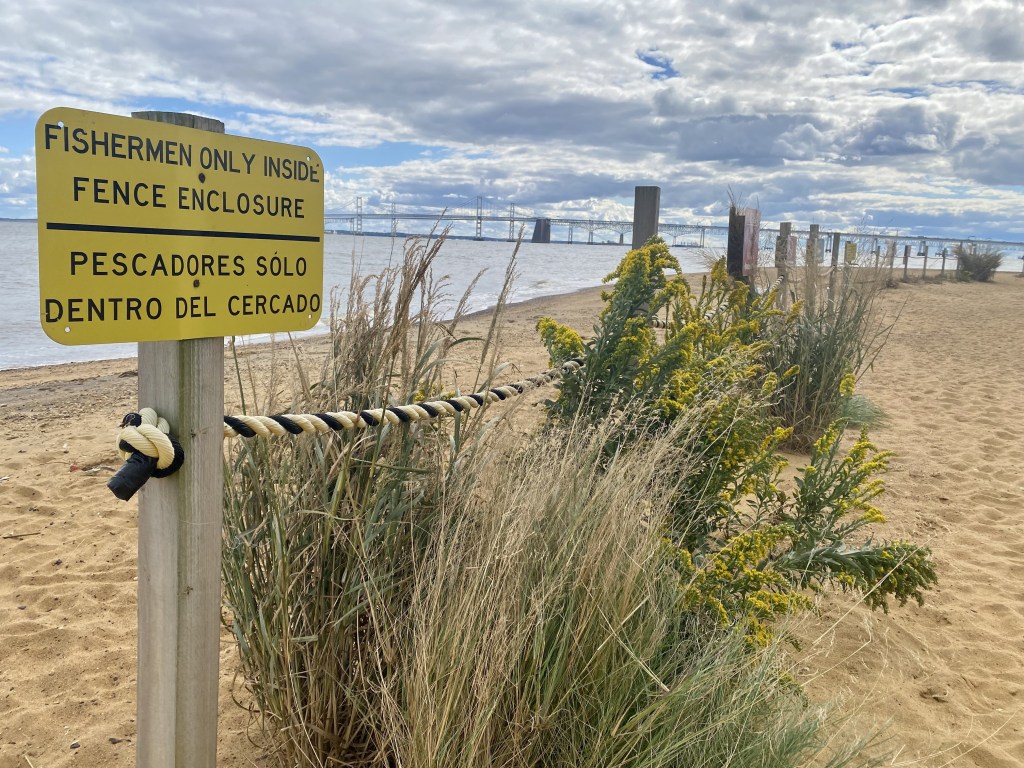
Chesapeake from Sandy Point
Anyway knowing about creek water emptying eventually to the Chesapeake mattered to me as a kid, in a way that touched that bigness I could feel but did not understand. And when I think of my childhood and my first connection to nature, what comes up for me now is show me a Marylander hyped up on Baltimore anything and steamed crabs who reps the state like it makes me laugh to admit I do, and I’ll show you a Marylander who lives some place near enough to trees that have a creek.
I’ll show you a people who even if they don’t, understand tides.
We come from the watershed of the great Chesapeake basin. And that is a fact that has shaped the movement of us. In part because elements, and this isn’t just poetry here, are in our blood. Chesapeake maps us.
I am going to tell you now about my connection to the Wicomico. This is a river on the eastern shore. If you’re unfamiliar the Chesapeake Bay divides Maryland into a western inland state and an eastern coastal side called the eastern shore. The Wicomico is a river on the lower eastern shore of Maryland, not too far from where the state ends and becomes Virginia.
Wicomico first called to me during the early summers of the Free School. In those years the Free School gathered on Assateague island a lot and connected to the earth and the elements there. In those years also I used to drive the backroads of Worcester and Somerset and Wicomico counties and also take small solo adventures down and up the coast on the whole peninsula. I took a ferry a mere few city blocks over Wicomico outside Eden one day on what is said to be the oldest running ferry spot still in operation in the states. I learned where to hike along Wicomico on these drives, to fish or crab, even to swim.
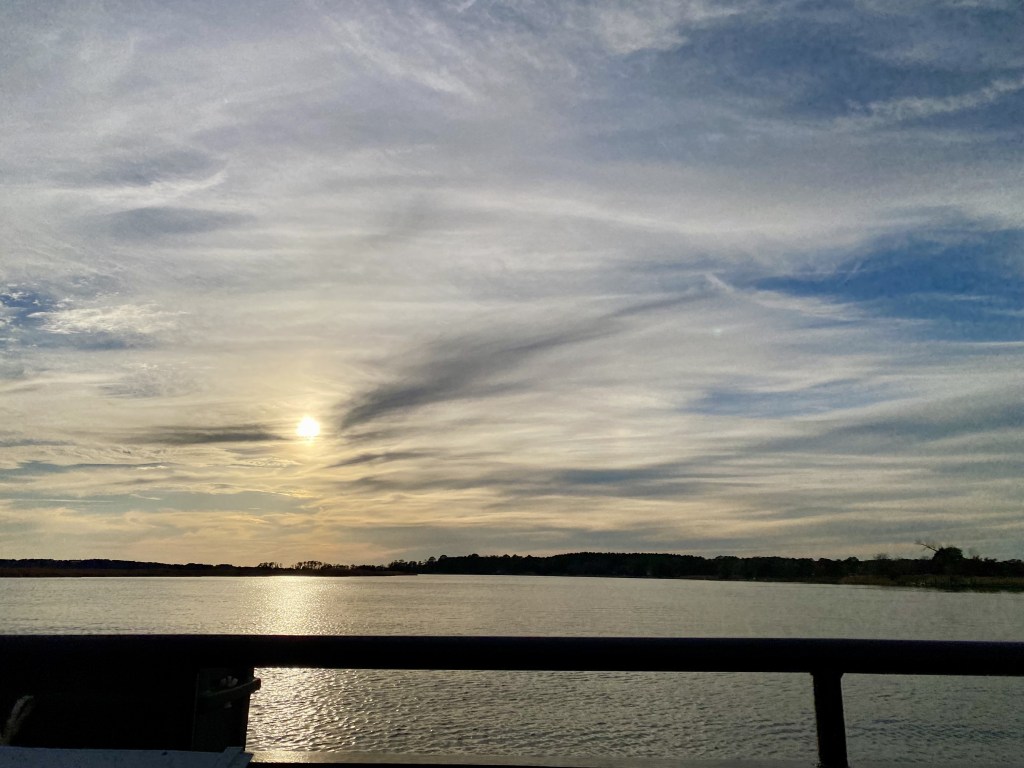
From the ferry
On these road trips I’d always find someplace to pull off and sit quiet on the land. As much as I could. It was important to me to understand this place, Delmarva, with her locked thick green spaces. She’d moved me to tears out of dreams so homesick the last year I was in California I couldn’t barely stand it. These places I’d never been on the shore but I felt calling me some nights from my sleep, the feeling of living among the land. I came home from the west and had to go out out driving on the eastern shore to understand this.
A bit later, 2021 I moved to Wicomico county and had a baby in a hospital across the street from where the Wicomico river runs through Salisbury. Early this year, January, I said goodbye to my grandmother on the other side of that river from the hospital where I gave birth. You can see the same hospital and the river both from the nursing home windows where the last cogent thing my grandma told me in her last in and out days was that she was going home.
Grandma is on my mind because the way I walk mindfully through the year is by honoring the seasons passing. At the start of fall I think of ancestors. It is a time I also practice turning towards my connection with water.
Like the memory of orange creek bed. Who led me to the river, to the Chesapeake, to the Wicomico, my baby, my grandma. My home.
West is the direction of the fall so that autumn is like a long season of the sunset, and already it has started here on the lower shore country side with signs in nature of early fall reflected all around us. Ancestor season is to revere and celebrate the wisdom of who and what has brought us here. It’s time for sitting with roots and considering what is steadfast. What holds us steady through seasons and seasons of change.
Fall is a time for connecting to passing and hoping for what’s to come. A time for remembering our resiliency as earth reminds us how many cycles of change we’ve already lived through. A season to remind us of all that also comes again. In the forest here at the free school where the old tulip trees stand, just south there is a bit of an incline and a short path to a lodge of loblollies. After spending a year or more sitting still in the forest we cleared the path through those pines and decided to tend it as the ancestor grove. A space provided to walk quiet in acknowledgement of those that are passed.
This essay is my little love note to fall, Witnessing Water. On big and tiny holy things. It’s also an invitation to everyone to join me to walk the Ancestor grove at equinox, in the free school forest, and join a bonfire and sacred circle on Tuesday, September 24, from 6-8pm. Join us, we will welcome Fall! And talk more about meaningful connection to nature, how to improve the Chesapeake watershed, and what partners are here supporting those efforts. We will also have time to get quiet, connect more thoughtfully to ourselves, each other, and nature.


 The Delmarva Free School